
A C-arm is an X-ray imaging system named for the curved arm that connects its X-ray source and detector. The shape lets the imaging assembly move around a patient so a medical team can view anatomy, instruments, or devices from different angles during a procedure.
* A plain-English guide for healthcare facilities and clinical teams
A C-arm is a fluoroscopy system that uses X-rays to create images on a monitor during a medical procedure. Unlike conventional radiography, which is commonly used to capture individual still images, fluoroscopy can display motion or changes as they happen. The C-shaped gantry helps the imaging team position the X-ray source and detector around the area of interest without moving the patient for every view.
The term describes the equipment, not a medical service offered directly to patients. Coast to Coast Radiology rents mobile C-arm equipment to professional healthcare and training facilities. It does not provide patient imaging appointments or interpret medical images.
See the generator, detector, gantry, monitor, and imaging sequence explained step by step. Read How Does a C-Arm Work?
Learn how portable fluoroscopy is used and why mobility matters for facilities with changing schedules or rooms. Read What Is a Portable Fluoroscopy Machine?
Review rental terms, equipment options, delivery planning, setup scope, and the information CTCR needs to check availability. Explore C-arm rental options.
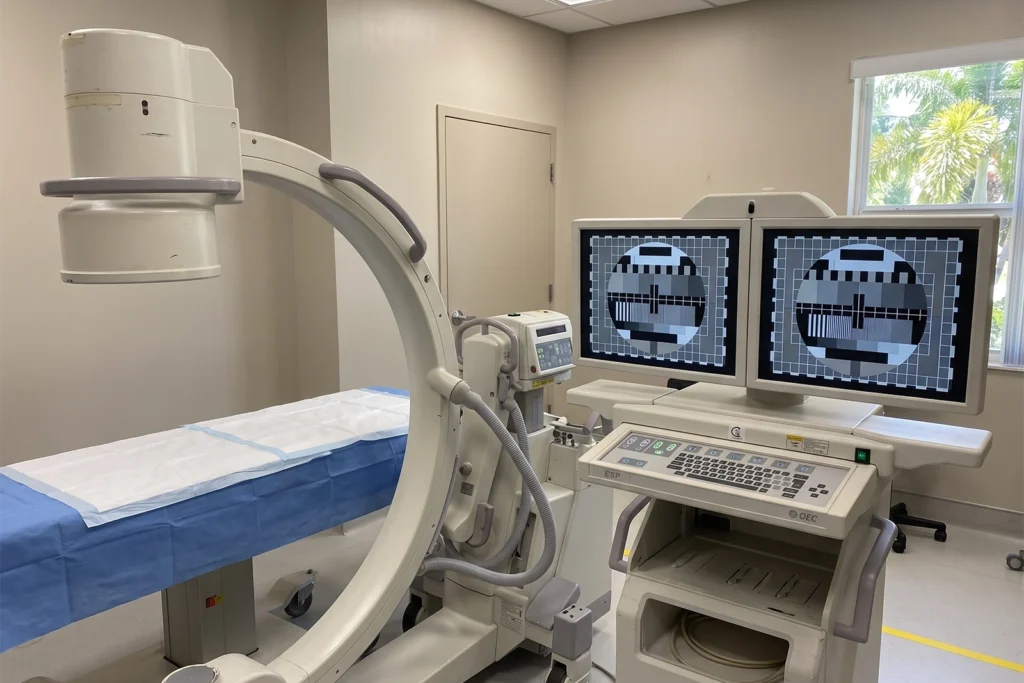
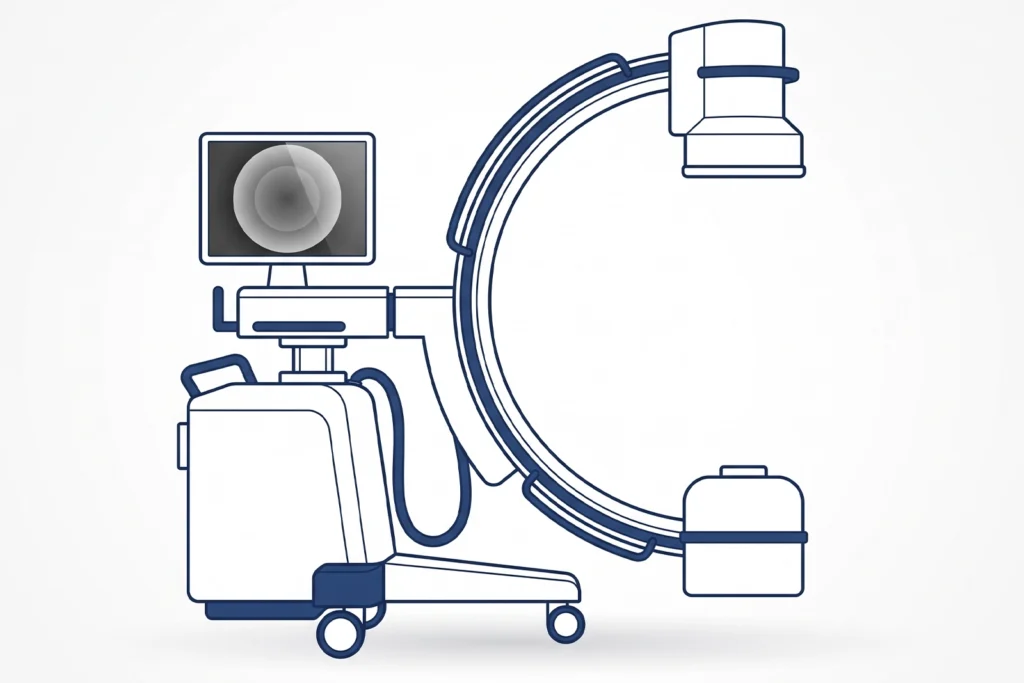
The X-ray source sits on one end of the C-shaped arm and the detector sits on the other. During imaging, X-rays pass through the area being examined. The detector receives the resulting X-ray pattern, and the system processes it into images displayed on a monitor.
Because the gantry can be repositioned, the medical team can obtain different views while the patient remains in place. Depending on the system and procedure, fluoroscopy may be continuous or pulsed. The facility’s qualified clinical team is responsible for selecting appropriate imaging modes, operating the equipment, and following its radiation-safety and quality-assurance program.
For the component-by-component explanation, positioning principles, and imaging sequence, visit How Does a C-Arm Work?
C-arms are commonly used when a medical team needs imaging during a procedure rather than only before or after it. The FDA describes fluoroscopy as a form of medical imaging that displays a continuous X-ray image on a monitor and notes that it may be used in diagnostic, interventional, and surgical procedures.
This list is educational, not a recommendation for any patient or procedure. A qualified medical team determines whether fluoroscopy is appropriate, which equipment and settings to use, and how radiation exposure will be managed. See the FDA overview of fluoroscopy.
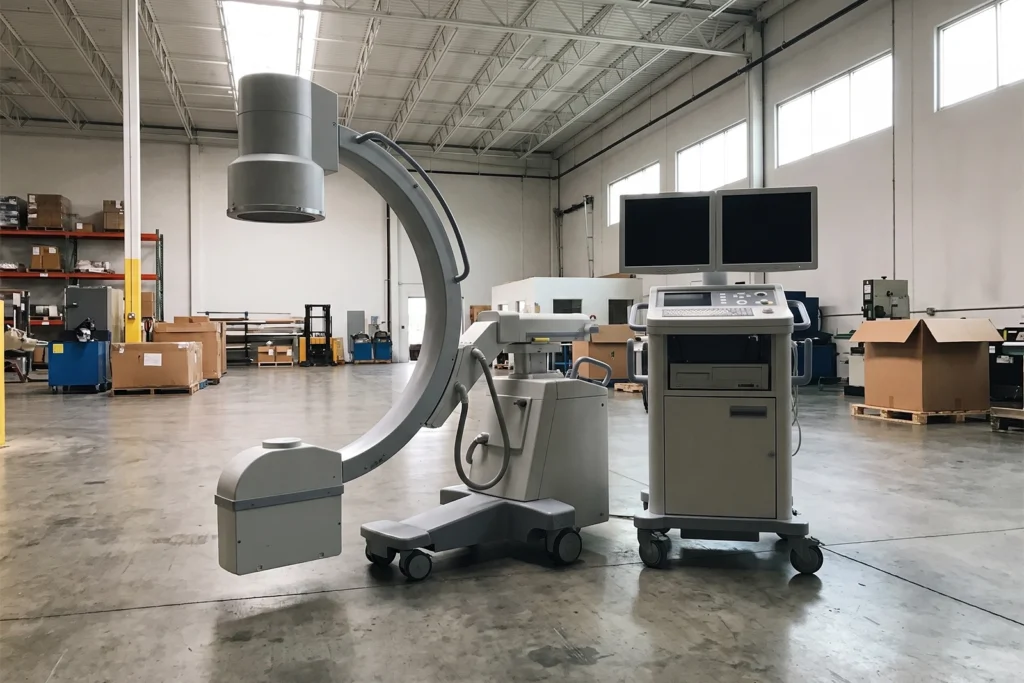
Full-size mobile C-arms are designed to move into operating rooms and procedure rooms while providing the reach and positioning range needed for many types of cases. Coast to Coast Radiology focuses on this category and works with GE OEC 9900 Elite and GE OEC 9800 systems. Individual configurations can vary. Compare the GE OEC 9900 Elite and 9800.
Mini C-arms are smaller systems generally designed around extremity imaging and more limited fields of view. Their size can make them useful in specialized settings, but smaller does not mean interchangeable with a full-size system.
Some fluoroscopy systems are permanently installed in dedicated rooms, and some newer mobile platforms offer advanced imaging capabilities such as 3D acquisition. Those systems serve different facility, procedure, space, and capital requirements than a conventional mobile C-arm rental.
CTCR rents mobile C-arm fluoroscopy systems, not conventional bedside radiography machines. Learn more about mobile C-arm X-ray machine rentals.
Tell the equipment provider what kinds of cases are planned and what the medical team expects from the system. The available unit and configuration still need to fit the intended work.
Loading access, doorways, elevators, hallway turns, room layout, power, and the route to the procedure room can all affect delivery and positioning.
A machine rental does not replace the facility’s clinical, credentialing, acceptance, quality-assurance, or radiation-safety responsibilities.
Ask what image display, storage, export, or documentation capabilities the medical team requires. Features can vary by unit and configuration.
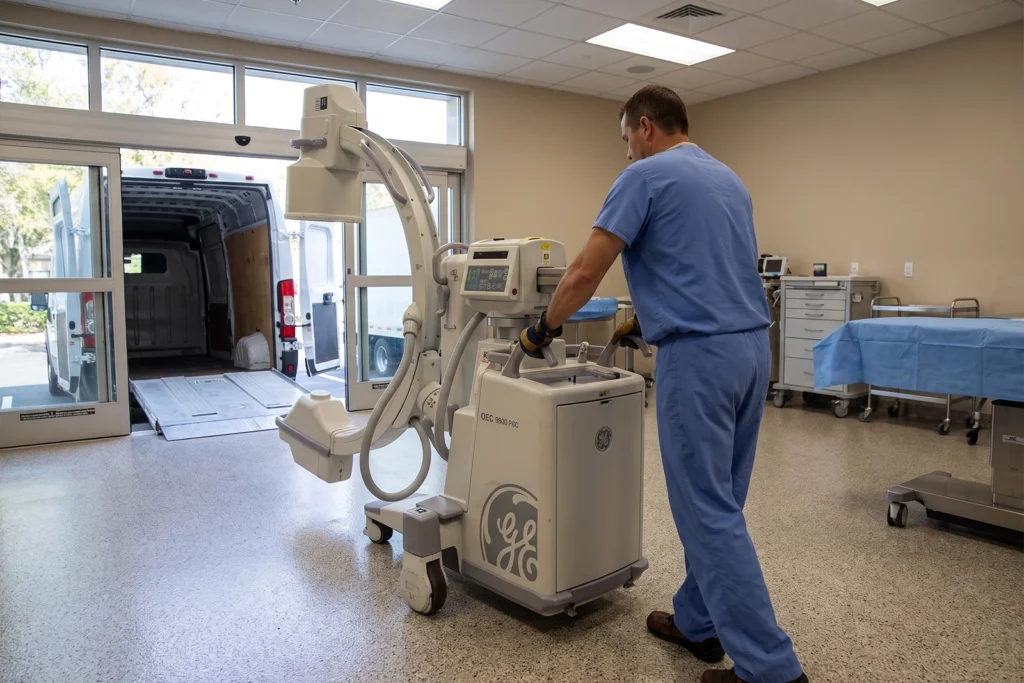
Facilities may need a C-arm for one procedure day, a recurring schedule, temporary capacity, a new room, or coverage while another system is being serviced. See the main C-arm rental guide.
C-arms use ionizing radiation. The amount involved varies with the procedure, equipment, settings, patient, imaging time, and other factors. The FDA advises that fluoroscopy be performed using the lowest acceptable exposure for the shortest time necessary and emphasizes trained operators, quality control, and patient-specific benefit-risk decisions. Equipment features do not replace qualified personnel, appropriate protocols, quality control, or the facility’s radiation-safety program. Read the FDA fluoroscopy safety information.
Depending on the facility, procedure, and equipment requirements, mobile C-arms may be used in hospitals, ambulatory surgery centers, pain-management practices, office-based procedure rooms, orthopedic and spine settings, medical-device training facilities, and cadaver labs.
Coast to Coast Radiology serves professional facilities throughout its Florida service area. CTCR does not schedule imaging appointments for patients.
It is named for the C-shaped gantry that holds the X-ray source and detector on opposite sides of the area being imaged.
Not exactly. Fluoroscopy is the imaging technique. A C-arm is a type of equipment used to perform fluoroscopic imaging.
No. A mobile C-arm provides fluoroscopic imaging during procedures. A conventional portable radiography machine is generally used to capture standard still X-ray images.
C-arms can support image guidance during orthopedic, pain-management, vascular, spine, urology, and other procedures. The qualified medical team determines whether the equipment is appropriate for a specific case.
Yes. C-arms use X-rays, which are a form of ionizing radiation. Facilities are responsible for trained operators, appropriate protocols, quality control, and radiation-safety practices.
Operation depends on applicable requirements, facility policy, and the procedure. Facilities should ensure that operators are appropriately qualified and trained.
Yes. Coast to Coast Radiology offers daily, weekly, monthly, and longer rental arrangements, subject to equipment, configuration, location, schedule, and availability.
No. CTCR rents mobile C-arm equipment to professional facilities. It does not schedule patient imaging appointments or interpret medical images.
Call Travis or Sean with the facility address, requested dates, procedure schedule, and any model or configuration requirements. Coast to Coast Radiology will check the fleet and explain the available equipment, delivery plan, rental scope, and next step.