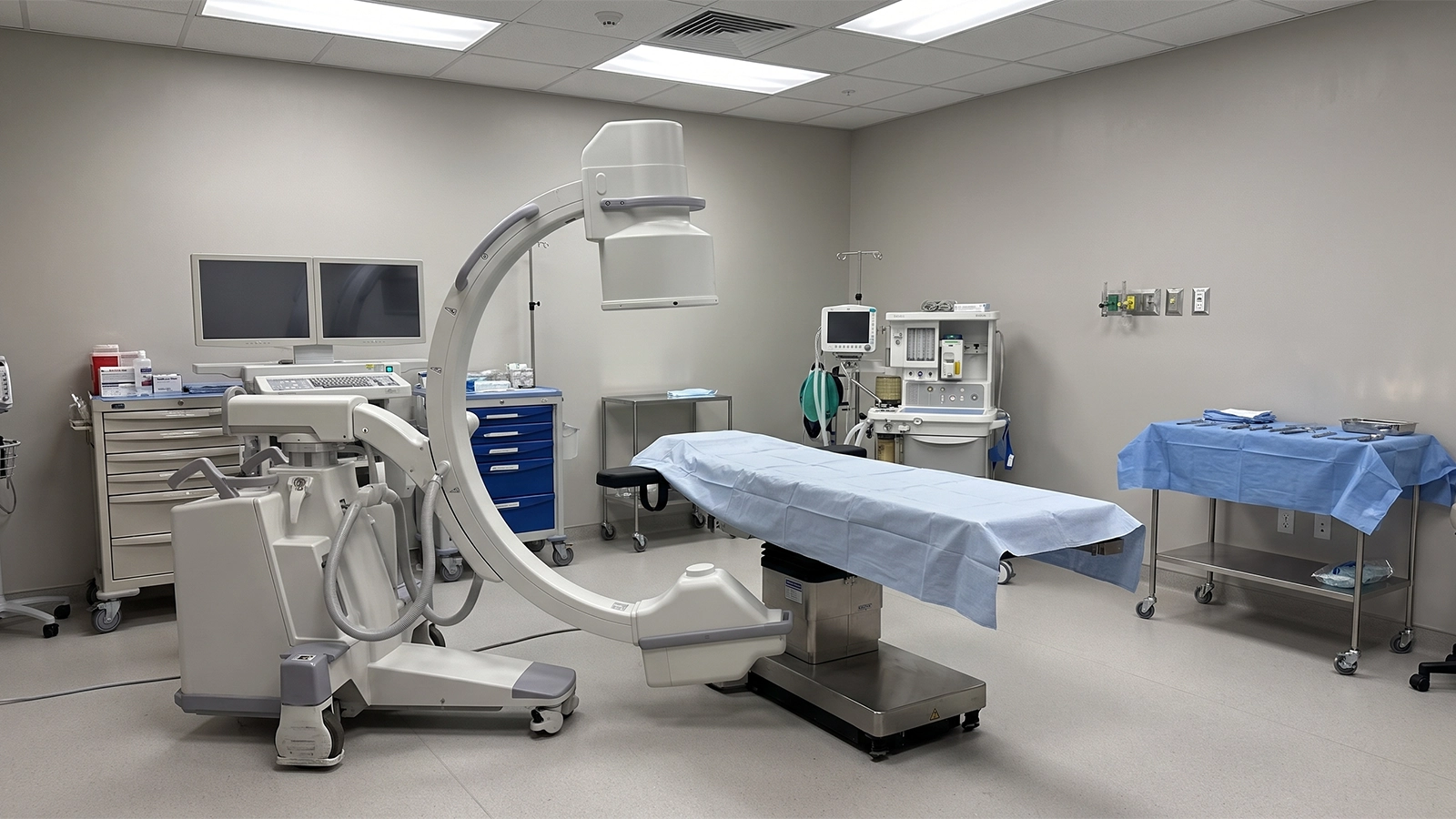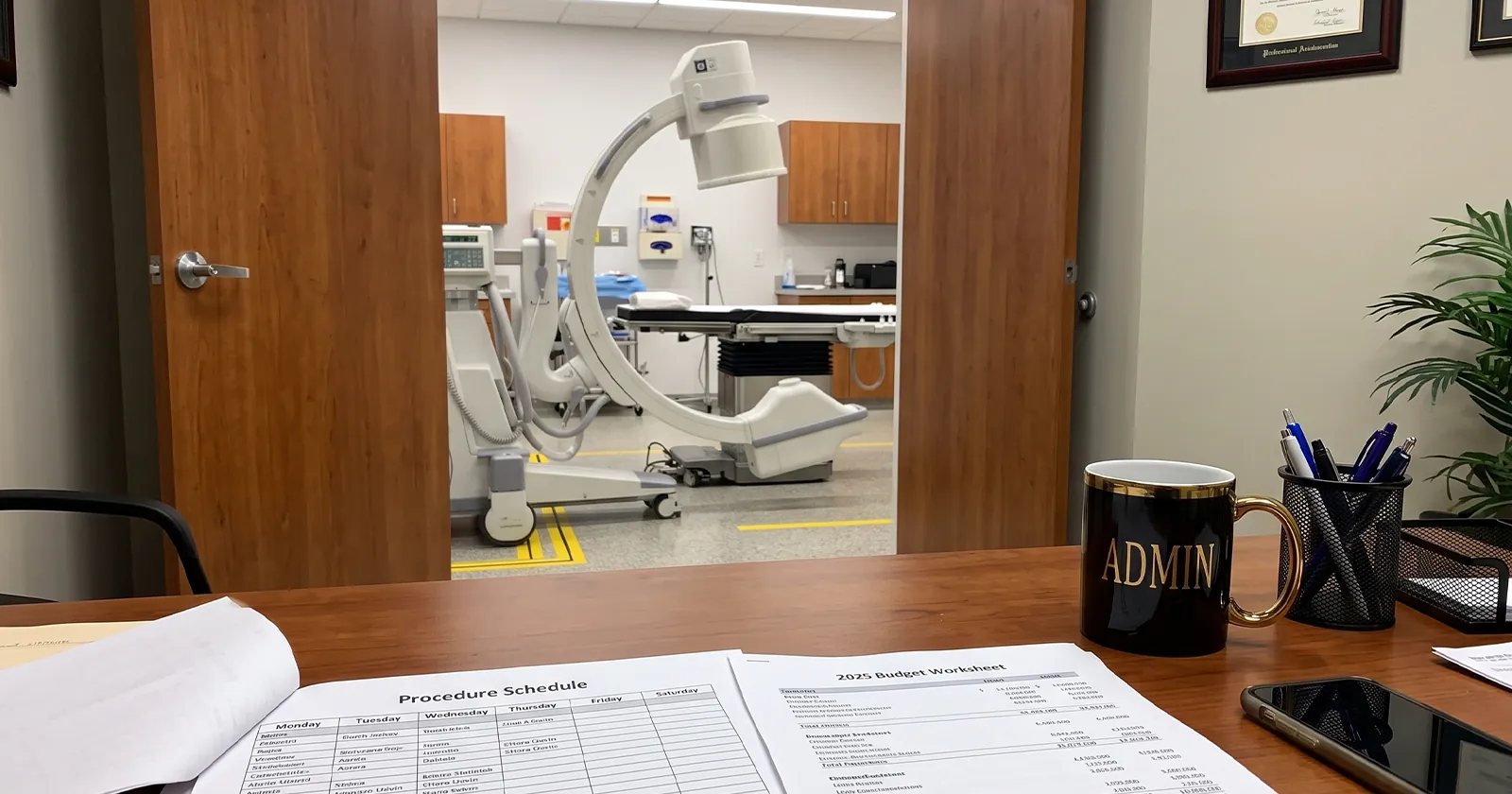
A portable fluoroscopy machine, usually a mobile C-arm, is a wheeled X-ray system that gives clinicians real-time images during diagnostic, interventional, and surgical procedures. Florida facilities may rent one for scheduled cases, added capacity, or temporary coverage when another unit is unavailable.
If you manage an OR schedule, you need more than a textbook definition. You need to know which machine fits the case, who is running it, when it will arrive, and who picks up the phone if something goes wrong.
Here is the plain-English version: what a portable fluoroscopy machine does, where it is used, and what to check before you put a rental on the schedule.
- Fleet of 20 Machines + 11 Trucks, Statewide
- Same-Day Delivery Across Florida
- 24/7 Direct Access to Travis & Sean
- GE OEC 9900 Elite Equipment
- All-Inclusive: Delivery, Setup & Retrieval
What Is a Portable Fluoroscopy Machine?
C-Arms: The Most Common Format
A portable fluoroscopy machine produces real-time X-ray images on a monitor. Unlike a standard radiograph that captures a single view, fluoroscopy can show motion and the position of anatomy, instruments, or contrast material as a procedure progresses. Depending on the equipment and the procedure, imaging may be continuous or pulsed.
The most common mobile format is the C-arm, named for its shape: an X-ray source sits at one end of the C-shaped gantry and an image detector at the other. The gantry can move around the patient to provide different views while the physician uses the images to guide a needle, catheter, implant, or other instrument.
What 'Portable' Actually Means in a Florida Procedure Room
Here, “portable” means the system is mobile instead of built into one imaging room. It can be delivered to the facility, rolled into the procedure room, and picked up when the rental is over. That works well for scheduled procedure days, changing case volume, or temporary coverage when another machine is down.
The part worth checking is whether the provider actually has the right unit available for your date and location. Before you lock in the schedule, get a clear answer on the model, delivery window, setup, and backup plan.
Fluoroscopy Capability vs. CTCR's Rental Role
Fluoroscopy can support diagnostic examinations as well as interventional and surgical procedures. The FDA’s overview of fluoroscopy includes diagnostic studies, catheter guidance, device placement, angiography, and orthopedic surgery among its uses. The GE OEC 9900 Elite is also cleared to provide images during diagnostic, surgical, and interventional procedures, according to its FDA 510(k) summary.
That does not make Coast to Coast Radiology a diagnostic imaging center. We rent mobile C-arm equipment to healthcare facilities for operating rooms and procedure rooms. We don’t schedule patient imaging appointments, interpret images, or provide MRI or CT services. The facility and its medical team decide how the equipment is used for each case.
How a C-Arm Fluoroscopy Unit Works in a Real Procedure Room
The Live Imaging Loop
When the system is activated, the X-ray source sends a beam through the patient and the detector captures what passes through. The workstation turns that information into images the medical team can see right away. The operator can move the C-arm for another angle and save images when the procedure calls for it.
Radiation dose is not one-size-fits-all. It changes with the procedure, imaging mode, exposure time, patient anatomy, and the way the system is operated. The FDA recommends using the lowest acceptable exposure for the shortest necessary time, which is why trained operators and the facility’s own safety protocols matter. If you want the component-by-component breakdown, read How Does a C-Arm Work?.
Setup in a Tampa or Orlando Surgery Center
Setup is easier when the details are handled before delivery day. The team needs to know where the truck can unload, how the unit gets to the room, which outlet it will use, and what checks the facility requires before the first case. A first-time delivery may take more coordination, so leave room in the schedule instead of trying to figure it out with a patient already waiting.
Ask one simple question before the rental: who handles what? Get clear on setup, cleaning between cases, moving the unit, and pickup so nobody is making assumptions in the procedure room.
What the Surgeon Sees on Screen
The clinical value is the real-time view. Depending on the procedure and the physician’s judgment, fluoroscopy can help visualize needle or catheter position, assess the placement of orthopedic hardware, or follow contrast material through the body.
Some mobile C-arm configurations can also capture and store images. If that matters to your workflow, ask about the exact model, software, storage, and export options before the machine arrives. The right answer depends on the unit, not just the fact that it is a C-arm.
Which Procedures Commonly Use Portable Fluoroscopy?
Mobile C-arms show up in surgery centers, ambulatory surgery centers (ASCs), hospitals, and office-based procedure rooms across Florida. The case determines the equipment and imaging protocol, so “we need a C-arm” is only the start of the conversation.
Pain Management
Fluoroscopic guidance is used in many pain-management procedures, including certain epidural injections, facet and medial branch blocks, radiofrequency procedures, spinal cord stimulator procedures, and sacroiliac joint injections. A mobile C-arm gives an office-based procedure facility access to real-time imaging without building the whole room around a fixed system.
Orthopedic Surgery
Orthopedic teams may use fluoroscopy during fracture treatment, joint procedures, and cases involving screws, plates, rods, or other hardware. Whether it is required depends on the procedure and the treating physician’s plan.
General Surgery and GI
Fluoroscopy may be used during procedures such as endoscopic retrograde cholangiopancreatography (ERCP), cholangiography, certain tube placements, and selected foreign-body retrievals.
Vascular, Cardiology, and Urology
Fluoroscopic guidance is also used in selected vascular, cardiac, and urologic procedures, including some catheter and stent placements. The FDA lists catheter guidance, device placement, angiography, and orthopedic surgery among common examples.
If fluoroscopy is part of the plan, don’t wait until the morning of the case to sort out the details. Confirm the machine, qualified personnel, room, and backup process ahead of time.
Planning Portable C-Arm Rentals in Tampa and Orlando
Tampa and Orlando facilities rent mobile C-arms for scheduled procedure days, extra capacity, and coverage when another unit is out of service. The hard part is rarely understanding what a C-arm does. It is getting the right machine, operator, delivery window, and room lined up before the first case.
Scheduling for a Tampa-Area Facility
For a Tampa-area facility, ask how availability is confirmed and what the provider needs to know about the cases. If you run the same schedule every week or month, share those dates early instead of starting from scratch every time.
Scheduling for an Orlando-Area Facility
The same goes for Orlando. Whether you need the unit for one day or on a recurring schedule, get the model, configuration, delivery access, operator arrangements, support contact, and backup plan settled before the rental date.
Statewide Rental vs. Local Vendor: What Florida Facilities Actually Need
If your group has locations in more than one Florida market, one rental contact can save a lot of back-and-forth. Just make sure “statewide” means the provider can actually cover your addresses and timeline. Ask about lead time, available equipment, after-hours support, and how multiple locations are billed.
Portable Fluoroscopy vs. Fixed Systems: Which Fits the Facility?
The Fixed System Reality for Smaller Florida Facilities
A fixed fluoroscopy system lives in a dedicated room and can make sense for a facility with steady demand and the infrastructure to support it. But the machine price is only part of the decision. Installation, room construction, service, compliance, staffing, utilization, and downtime all belong in the math. There is no magic case-volume number that works for every facility.
When the Rental Model Makes Sense
Renting can make sense for temporary needs, recurring procedure days, a new practice, seasonal demand, or backup coverage. Ownership may fit a facility with steady, predictable use. Put the full costs and day-to-day responsibilities side by side before deciding; neither option is automatically cheaper for everyone.
The Flexibility Factor
Renting also gives a growing practice room to test another procedure day or location before committing to another machine. If expansion is on the calendar, bring it up early so equipment availability does not become the last-minute problem.
Who Rents Portable Fluoroscopy Equipment in Florida?
Not every facility rents for the same reason. Some have planned procedure days. Some are opening a new service line. Others need temporary coverage while their own equipment is being serviced. The common thread is simple: they need the right machine without buying a permanent system for every location or schedule.
The Typical Florida Rental Client
- Ambulatory surgery centers (ASCs) covering scheduled cases, temporary capacity, or equipment downtime.
- Pain-management practices with recurring procedure schedules.
- Orthopedic practices that need real-time imaging for selected procedures.
- New facilities that are evaluating utilization before making a long-term equipment decision.
- Hospitals and other facilities during planned maintenance or periods of temporary demand.
The Pain Management Physician Opening a New Practice
A physician opening a pain-management practice may need fluoroscopy before the case volume supports buying a machine. A rental can bridge that gap while the practice learns its real utilization, staffing needs, room requirements, and long-term equipment plan.
The machine is only one piece of opening the procedure room. The practice still needs the right licensing, credentialing, radiation-safety procedures, qualified personnel, room preparation, and clinical protocols. Renting can solve the equipment question; it does not replace the rest of the setup.
What to Look For in a Portable Fluoroscopy Rental in Florida
Start with the cases you are running, then get the equipment and service details in writing. A few direct questions will tell you more than a page full of promises.
Equipment Quality First
Ask for the exact model and configuration, not just “a C-arm.” Make sure it fits the procedures, room, power, image-management, and documentation needs. Ask how the unit is maintained and quality-checked, and include current manufacturer or FDA safety notices in the facility’s equipment review.
Who Actually Answers After Hours?
If you call after hours, find out who actually picks up. When tomorrow’s cases depend on a working C-arm, you need someone who can give you an answer, not just take a message. Ask who handles the call and what happens next.
Delivery, Setup, and Retrieval Included
Ask whether the quote covers delivery, room placement, setup, required equipment checks, and pickup. You should know what the rental company handles, what your team handles, and whether travel or after-hours service changes the price before the truck is on the road.
Backup and Breakdown Coverage
Ask the uncomfortable question before you need the answer: what happens if the machine has a problem? Find out who troubleshoots it, when a replacement is sent, and what response time the provider can commit to at your location. “Backup available” is not the same as a guaranteed same-day swap, so put any critical timing requirement in writing.
Statewide Coverage for Multi-Location Groups
If you manage more than one location, ask whether scheduling, billing, support, and equipment records can stay under one account. One contact is easier than rebuilding the same rental relationship in every market, but only if the provider can cover the actual addresses and dates you need.
Coast to Coast Radiology: Mobile C-Arm Services Across Florida
Coast to Coast Radiology rents mobile C-arm equipment to healthcare facilities throughout its Florida service area. Tell us where the machine needs to be, when you need it, and what kinds of cases you are running. We’ll give you a straight answer about the equipment and delivery options available for that request.
Delivery Without the Runaround: We coordinate delivery, setup, and pickup, then spell out what is included for your location and schedule.
Specific Equipment, Not Vague Promises: We work with GE OEC mobile C-arm models. Tell us what cases you are running and we’ll confirm the model, configuration, and availability.
Real People on the Phone: Rental calls go directly to Travis or Sean, including after-hours requests. You are talking to people who know the machines, the trucks, and the schedule, not someone reading from a call-center script.
One Call for More Than the Machine: If you also need a qualified technologist or repair help for your own unit, we can discuss what is available through our service partners. We’ll tell you who is providing each part so you know exactly who is responsible for what.
You can review the current options on our C-arm fluoroscopy machine rental page, but the fastest way to match a machine to a real case schedule is to call us.
Have a case coming up? Call **(941) 371-9659**. Tell Travis or Sean where the machine needs to be, when you need it, and what cases you are running. We’ll tell you what is available and what the delivery will involve.
Frequently Asked Questions
Can I rent for just one day?
Yes. CTCR offers daily, weekly, and monthly rentals. Tell us which machine you need, where it is going, and the dates you need it, and we’ll confirm the available options in the quote.
What is the difference between a C-arm and a portable X-ray machine?
A conventional portable radiography unit is generally used to capture individual X-ray images. A mobile C-arm provides real-time fluoroscopic imaging and may also capture spot images. Fluoroscopy can be used in diagnostic, interventional, and surgical procedures; the exact use depends on the equipment, facility, and clinical plan.
What happens if the machine breaks down during the rental?
Call us as soon as something looks wrong. We’ll work through the problem and tell you whether the unit needs to be replaced. Timing depends on the location, available equipment, and rental agreement, so discuss any critical response window before the procedure date.
Do you cover Tampa and Orlando?
Yes. CTCR serves facilities in both Tampa and Orlando. Give us the exact address and date, and we’ll confirm availability and delivery timing.
Do I need a certified X-ray technologist for the rental?
The machine and the operator are separate arrangements. If your facility does not already have appropriately qualified personnel, tell us when you call. CTCR may be able to coordinate a technologist through a staffing partner, depending on availability and separate terms.
Bring a C-Arm to Your Facility in Tampa or Orlando
Have a procedure on the calendar? Call (941) 371-9659 and talk directly with Travis or Sean. Tell us the facility, date, case type, and equipment requirements, and we’ll give you a straight answer about availability and delivery.