
A pain management physician in Fort Myers is opening her own practice next quarter. Build-out is almost done, the staff is hired, and the first month of cases is already on the schedule. There’s one decision left, and it’s the one keeping her up at night: does she buy a C-arm or rent one?
If you’ve ever sat with that question, you know it isn’t so simple. A C-arm is one of the biggest line items a surgery center, pain clinic, or orthopedic practice will ever sign for, so getting the answer right means protecting both your cash and your schedule. Get it wrong and you’re either making payments on equipment that sits idle three days a week or scrambling for backup imaging when your only unit goes down on a Tuesday morning.
The numbers below are real, the tradeoffs are honest, and the scenarios cover most of what Florida facilities actually run into when they sit down with the rent-or-buy question.
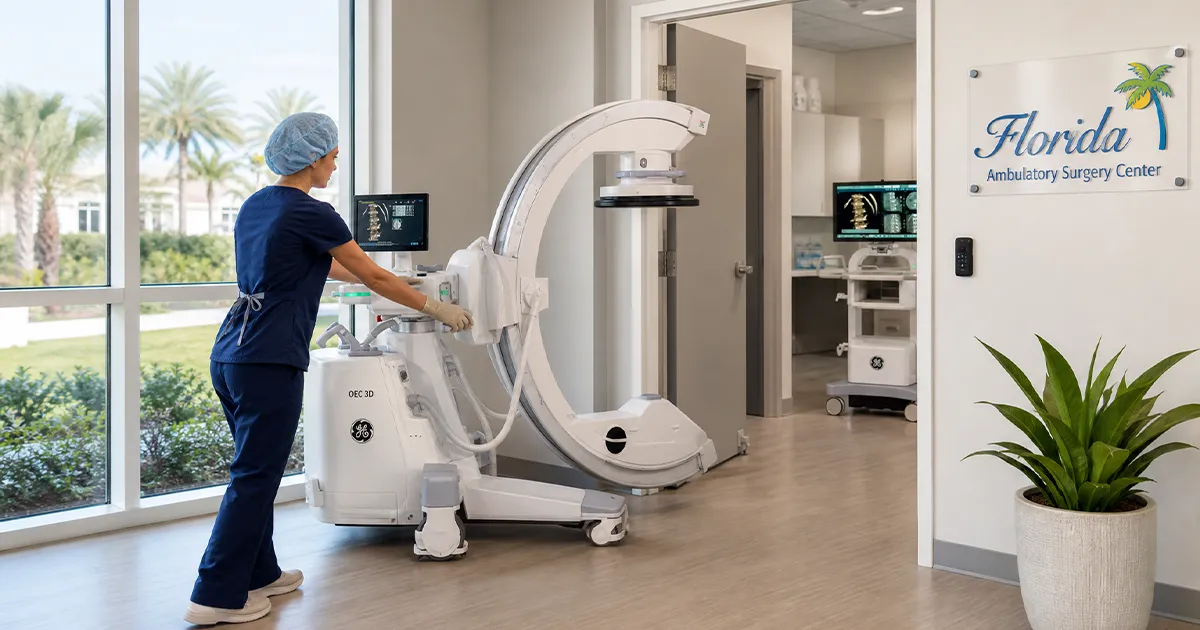
The sticker price is just the start. As you may know, a new GE OEC 9900 Elite, the workhorse of most Florida surgery centers, runs roughly $80,000 to $150,000 or more depending on configuration. On top of that, a solid refurbished unit lands in the $30,000 to $70,000 range, and those are publicly known market ranges, not anyone’s secret pricing.
That number makes most administrators take a breath, but it’s not the number you should be worried about: the real cost of ownership shows up after the truck leaves the loading dock. Here they are:
Add it up and the all-in cost of owning a C-arm over five years can easily run 1.5 to 2 times the purchase price, and that’s before counting the cases you cancel when something breaks.
Renting works on a different math entirely: you pay for the equipment when you use it, and the rest of those line items move off your balance sheet.
When you rent a GE OEC 9900 Elite or 9800 through Coast to Coast Radiology, here’s what’s included at no extra charge:
There’s no service contract to carry, no depreciation schedule to manage, and no annual recalibration to budget for. The rental price is the rental price.
That said, we don’t publish rental pricing online because it depends on your facility, how many days you need, and your case mix, since a one-day pain management block looks very different from a multi-week ortho rotation. So, the simplest move is to call and get a real number for your real situation.
Let’s be fair to ownership, because buying does make real financial sense in a specific scenario.
For example, let’s imagine you’re running a high-volume facility doing 5 or more cases per day, 5 days a week, with a stable case mix that’ll likely look the same three years from now. You also have the capital to absorb depreciation, the staff to handle preventive maintenance, a service contract budget already in place, and, more importantly, a real plan for what happens if the machine goes down mid-case.
If that describes you, buying probably pencils out. The per-case cost of owned equipment at high volume beats rental over the long haul, so a busy multi-room ASC in Miami or Tampa doing pain, ortho, and podiatry every day can absolutely put ownership on the table.
Renting fits more situations than ownership does, and the scenarios below cover the cases we see most often.
You don’t know what your case volume will look like in six months. Most physicians opening pain management or in-office surgery practices think they have a solid projection, but many of them end up being off by a meaningful margin in either direction. That’s exactly why renting makes sense early on, since it lets cost follow actual volume instead of locking in a capital expense against projections that may not survive the first quarter.
It also gives you room to learn which equipment model actually fits your procedure mix before committing to one. After all, a $100,000 buying decision gets a whole lot easier once you know what your schedule actually looks like by month four.
Volume swings are expensive when you own, because a slow week costs you the same as a busy one. Rental doesn’t work that way.
Running cases across two or three sites changes the math significantly. Suddenly, owning means either buying multiple units or shuttling a single machine between locations, which leads to wear accumulation, calibration drift between moves, and the constant scheduling headache of figuring out which site gets the machine on which day.
And honestly, a lot of multi-site practices don’t fully account for those coordination costs until they’re already dealing with them. That’s where renting simplifies things.
A calibrated GE OEC unit shows up at each location on the day you need it, no logistics puzzle required.
Even facilities that own their primary C-arm still rent for overflow, especially during busy block weeks or when their primary machine goes in for service and they need temporary coverage.
Reps and manufacturers run hands-on training across Florida constantly, and renting for those events is cleaner than borrowing internally or carrying a dedicated training unit.
Practices that think they want to buy will often rent for 60 or 90 days first to see what real utilization looks like, because that data makes the eventual buy-or-don’t-buy decision a real one, not a guess.
It’s not on anyone’s spreadsheet, and it’s probably the most expensive line item in the whole conversation.
Picture it: Tuesday, 7:00 a.m., Naples and you own a C-arm, there are 8 cases on the schedule, and the tech powers on the unit to find nothing happens. Or worse, the self-test passes and an error code lands halfway through your second case.
Now what? You’re calling your service provider, and the best response you’ll hear is “later today” or “tomorrow.” Your surgeon is in the hallway, your front desk is calling 8 patients, and billing takes a hit on every cancellation. If those cases were referred by a surgeon you’re trying to build a relationship with, you’re taking a hit there too.
Renting from a fleet operator with real coverage changes what a breakdown means. Instead of a four-hour fire drill, it’s a phone call. At Coast to Coast Radiology, an emergency breakdown means deploying a replacement from a fleet of roughly 20 machines and 11 trucks staged across Florida, so your cases keep moving.
That’s the difference with rental coverage: ownership gives you a service ticket.
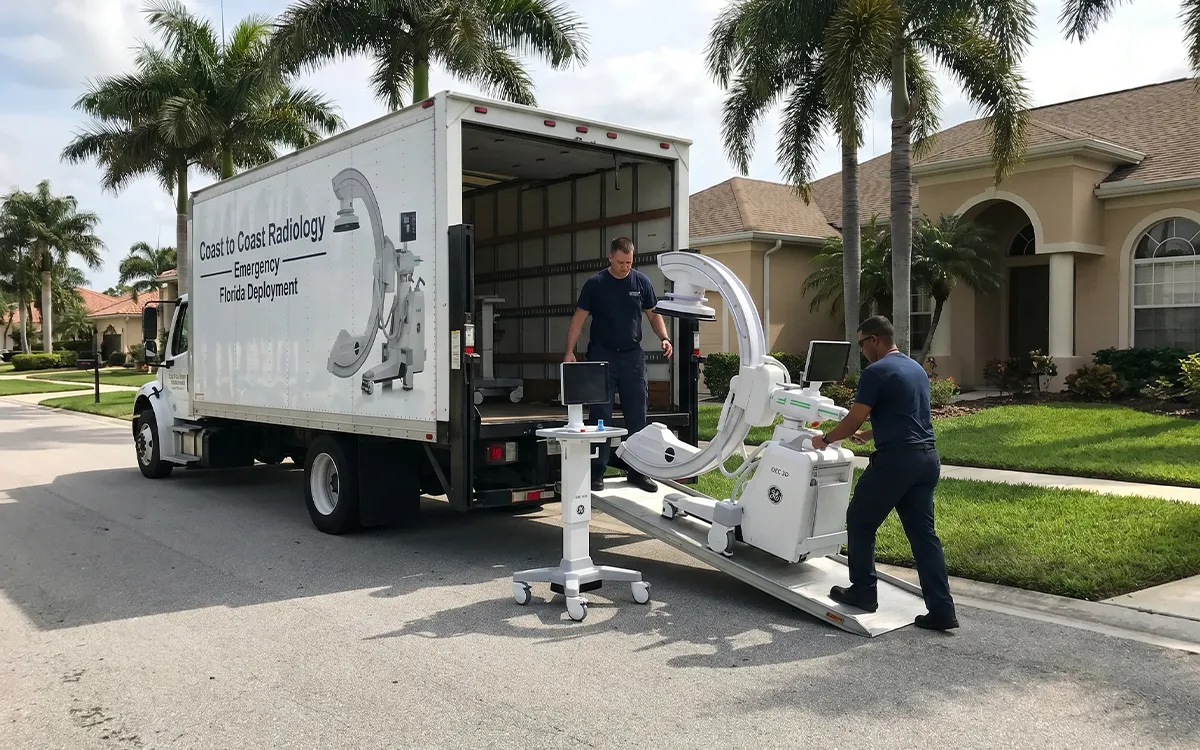
When evaluating fluoroscopy equipment rental options in Florida, the company you choose matters as much as the decision to rent itself. If you’re putting revenue-critical equipment in someone else’s hands, these are the questions worth asking before you sign anything.
If the answers take a callback, keep looking.
If you’re running a high-volume, predictable, multi-room ASC and you’ve already budgeted for service, calibration, training, depreciation, and real downtime coverage, buying is a fine decision.
For everyone else, and that’s most Florida facilities, renting makes more financial sense. You preserve capital, skip the maintenance overhead, remove the downtime risk, and still get the same GE OEC 9900 Elite your surgeons already know how to use.
Coast to Coast Radiology rents the GE OEC 9900 Elite and 9800 statewide across Florida. Delivery, setup, calibration, retrieval, and emergency replacement are all included, and the owners answer the phone day or night.
If you’re working through the rent vs buy c-arm decision and want a real number for your real schedule, call (941) 371-9659. We’ll give you a straight answer and let you make the call from there.
Pricing depends on location, rental duration, and whether you need daily, weekly, or monthly terms. Coast to Coast Radiology doesn’t publish rates online because the right number depends on your facility’s specific situation. Call (941) 371-9659 for a quote built around your actual schedule.
Rentals run from a single day up to multi-month terms. Coast to Coast has clients who’ve maintained ongoing rentals for years as a cost-effective alternative to purchasing, and long-term arrangements come with negotiable pricing.
For most practices in the startup phase, renting makes more financial sense. The honest answer is that it depends on your projected volume, and most new practices don’t have reliable volume data until they’ve been open for at least a quarter. Renting for the first 60 to 90 days gives you real utilization numbers before you commit $80,000 or more to a purchase. Once you know what your schedule actually looks like, the buy-or-don’t-buy decision becomes straightforward instead of a guess.
Coast to Coast Radiology rents the GE OEC 9900 Elite and the GE OEC 9800, both of which are the standard models used in Florida surgery centers, pain management clinics, and orthopedic practices. Every unit arrives calibrated and ready for your first case.