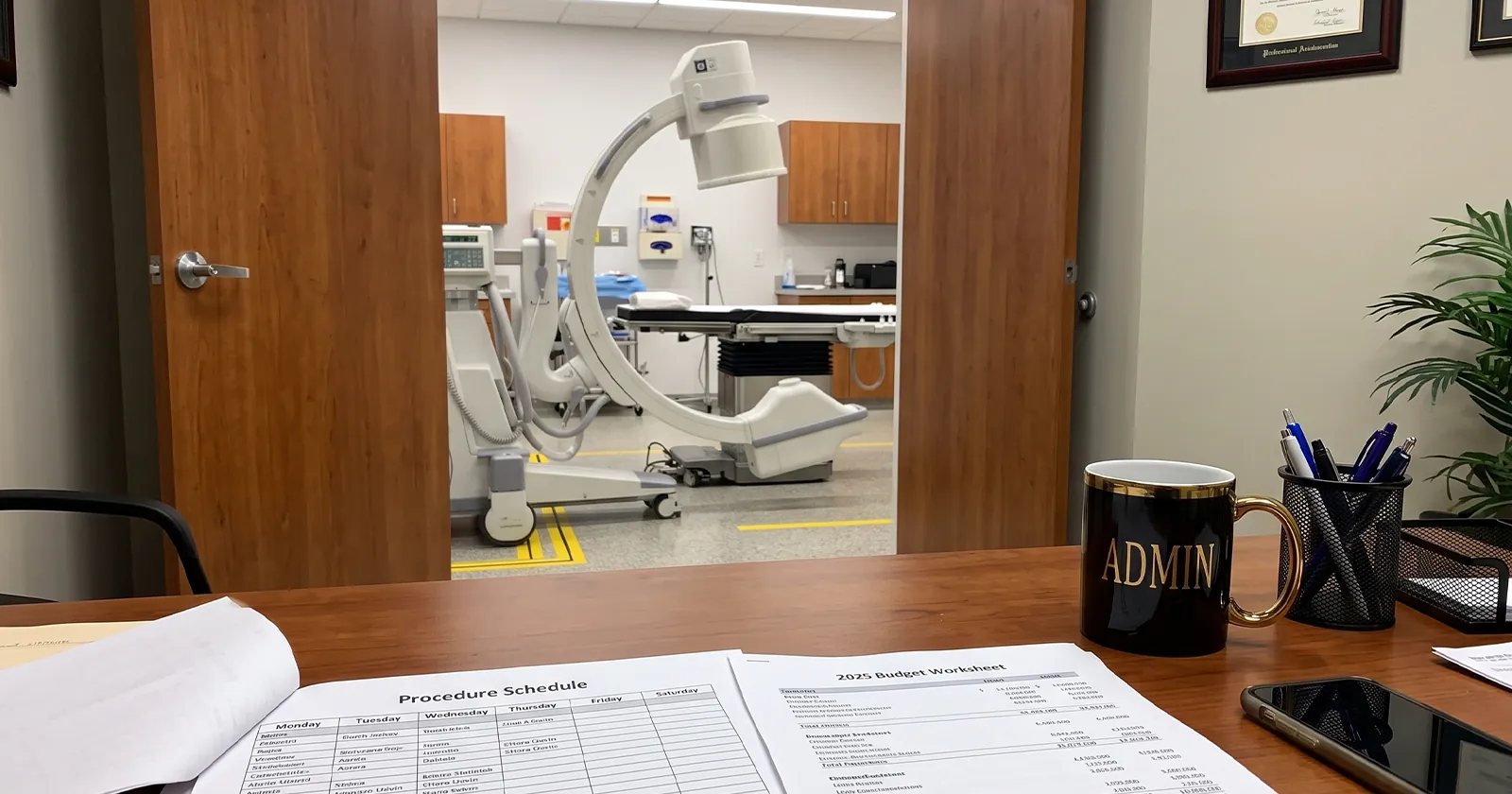
A surgery center administrator in Clearwater pulls a quote for a refurbished C-arm, sees one number at the bottom, and forwards it to the medical director with a note that says “this is doable.” Eight months later the service agreement renews, the tube is showing wear, and that number turns out to have been the smallest line on the list.
That gap is the whole problem with the way fluoroscopy equipment cost gets evaluated. The purchase price is one item out of roughly a dozen, and the items nobody prints on the quote are the ones that decide whether owning or renting is cheaper for your facility.
What follows is the full list in both columns, plus the arithmetic that tells you which column you belong in. Current dollar ranges by machine class live in our C-Arm Cost Guide. This breakdown is about the categories those numbers sit inside and how to run them against your own schedule.
- Fleet of 20 Machines + 11 Trucks, Statewide
- Same-Day Delivery Across Florida
- 24/7 Direct Access to Travis & Sean
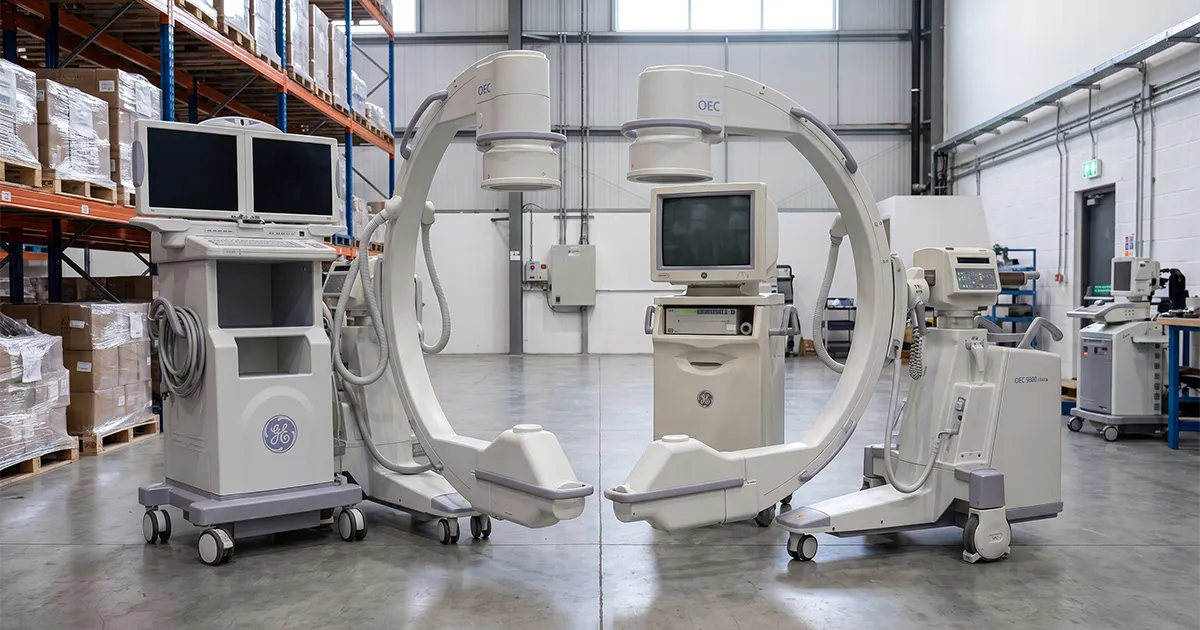
- GE OEC 9900 Elite and 9800 Available
- All-Inclusive: Delivery, Setup & Retrieval
What Fluoroscopy Equipment Cost Actually Includes
The Number on the Quote
The quoted price covers the machine and nothing else, which is why two facilities can buy the identical unit in the same month and sit thousands of dollars apart by year two. Everything that keeps a unit legal, calibrated, staffed, and running falls outside that figure, and most of it recurs annually.
The Four Categories Behind It
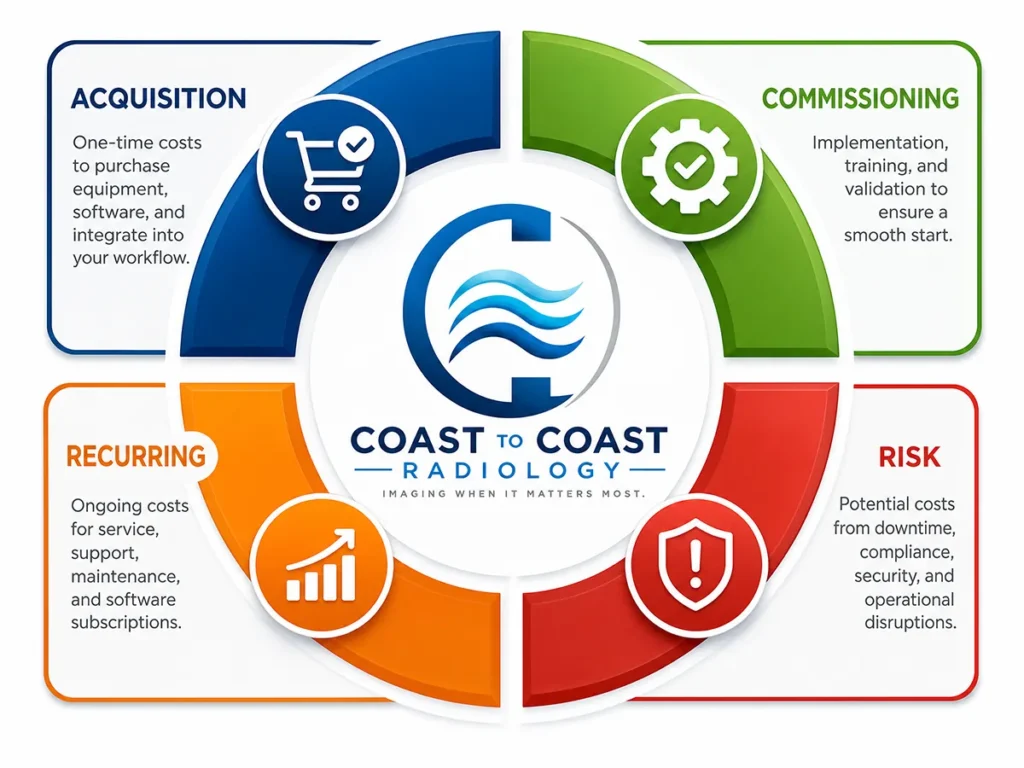
Break the real cost into four buckets and the comparison gets much easier to run. Acquisition is the capital you commit and what committing it costs you. Commissioning is the one-time work of getting the unit into your room and your staff onto it. The recurring load covers service, compliance, and consumables year after year. Risk covers what happens on the days the machine is not working. A rental collapses three of those four into one rate, and that is the actual mechanical difference between the two paths.
Why the Categories Matter More Than the Ranges
Published ranges are wide because machine class, age, configuration, and seller all move the number, so a range tells you very little about your own situation. The categories are the same for every facility, and once you know which ones apply and roughly how heavy each one is, you can price your own decision instead of borrowing someone else’s. One thing worth settling first: this is fluoroscopy and C-arm equipment for operating rooms and procedure rooms, not diagnostic imaging gear, and the FDA’s fluoroscopy overview covers the clinical side of that distinction.
The Purchase Column, Line by Line
Acquisition and Financing
Capital is the obvious line and the cost of that capital is the one that gets skipped. Financing carries interest, a cash purchase carries opportunity cost against whatever else that money would have done, and either way the asset starts depreciating on delivery day. Depreciation is why a five-year-old unit resells for a fraction of what you paid, and IRS Publication 946 is the reference your accountant will be working from.
Commissioning: Delivery, Install, and Training
Getting the unit from seller to working state is its own line: freight, uncrating, positioning, power and shielding checks on the room, acceptance testing, then training whoever will run it. None of it is optional and none of it is usually quoted with the machine. Because it is one-time rather than recurring it tends to get waved off during the decision and then arrives in full on the first invoice cycle.
The Recurring Annual Load
This bucket separates the two paths more than any other, because it renews every year the machine sits on your floor. A service agreement on a full-size unit is a five-figure annual line for most facilities, and going without one means a single board or tube replacement can exceed what a year of coverage would have cost. Stacked on top of it: annual preventive maintenance and calibration, equipment registration and inspection under Florida’s Bureau of Radiation Control, your radiation safety program and dosimetry, insurance on the asset, and continuing education for the licensed technologist who operates it. Individually none of these are dramatic, but multiplied across five years they are frequently the largest number in the whole exercise.
The Reserve Most Budgets Skip
X-ray tubes and image intensifiers are consumable parts with finite service lives, so a facility that owns a C-arm long enough replaces one or both eventually, at capital scale rather than maintenance scale. Facilities that plan for it carry a reserve. Facilities that do not end up funding it out of a quarter they had earmarked for something else.
The Rental Column, Line by Line
What the Rate Already Covers
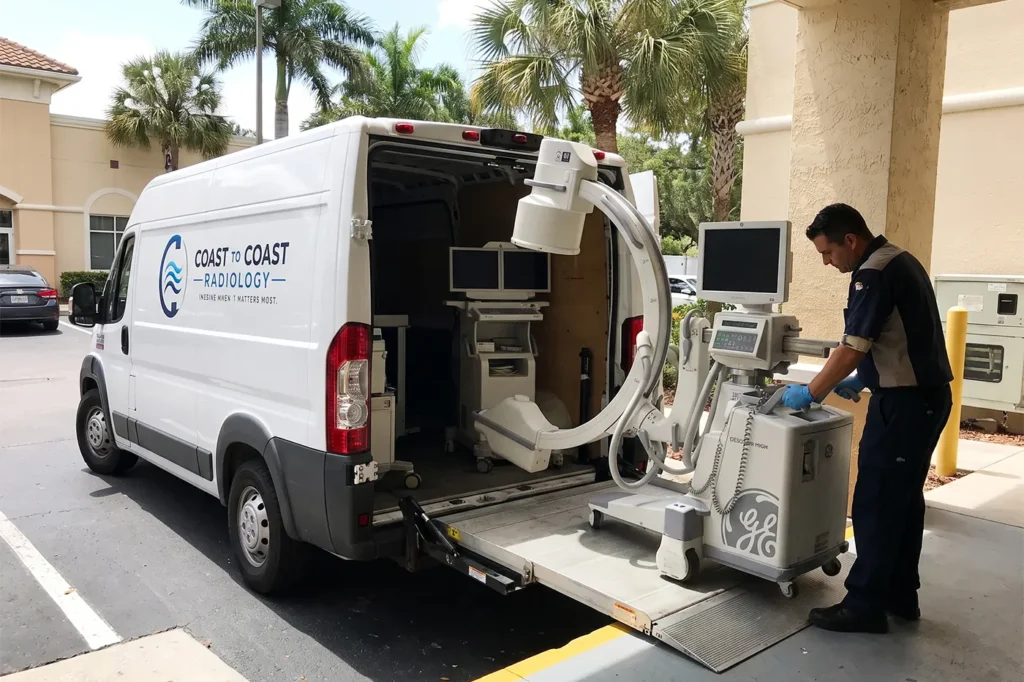
The rental column is short, which is the point of it. With Coast to Coast Radiology the rate covers delivery anywhere in Florida, setup and calibration in your room before the first case, retrieval when you are done, and a working machine for the duration. If a unit fails mid-rental, replacing it is our problem, and with roughly 20 machines and 11 trucks staged across both coasts there is inventory to replace it from.
What Comes Off Your Books Entirely
Renting removes the acquisition line, the financing cost, the depreciation schedule, the annual service agreement, the calibration cycle, the tube and intensifier reserve, and insurance on an asset you do not own. Those are gone rather than deferred, which is a structural difference and not a matter of degree. If you also need a certified technologist, our partnership with Precision On Call gets that coordinated on the same call instead of turning into a second vendor relationship you have to manage.
What Stays Yours Either Way
Renting is not a way around every obligation, and being straight about that matters more than a clean sales line. Your facility still owns its radiation safety program, its staff credentialing, its state and accreditation obligations, and the room the equipment goes into. What changes is that the machine is no longer yours to carry as a capital asset.
The Utilization Math That Settles It
Cost Per Case, Not Cost Per Machine
Holding a purchase price next to a rental rate compares two different units of measurement, and it is the most common way this decision gets made badly. The fair comparison is cost per case: take the all-in five-year cost of ownership from the four categories above, divide by the cases you realistically expect the unit to support in that window, and hold the result against a rental rate multiplied by the days you would actually need a unit in the room.
Finding Your Crossover Point
Run that division at three volume assumptions rather than one: the schedule you have today, the schedule you expect in two years, and the schedule you would have if a referral source went quiet. Ownership beats rental on cost per case only above a certain utilization, and the useful output here is locating that line for your own facility rather than arguing about which option is cheaper in general. Below the crossover, every idle day is a day you paid for a machine that did nothing.
Where Projections Go Wrong
New practices and newly opened surgery centers land on the wrong side of this calculation more than anyone else, and the reason is simple: the case volume in the pro forma is a guess, and month four rarely matches it in either direction. Renting for the first 60 to 90 days turns that guess into real utilization data, at which point the crossover math has actual inputs. Our post on C-arm rental vs. purchase for Florida facilities walks through where that plays out.
The Line Item That Never Makes the Spreadsheet
What a Cancelled Block Costs
Downtime is missing from almost every rent-or-buy comparison and it is often the most expensive category in the model. A C-arm that fails at 6:45 on a Tuesday morning does not cost you a repair bill, it costs you the block: the cancelled cases, the staff already clocked in, the patients your front desk spends the morning calling, and the referring surgeon who now has a reason to look elsewhere. Price one cancelled surgical day honestly and it dwarfs years of the maintenance lines people argue over.
How the Replacement Path Differs
The difference between owning and renting that Tuesday is not the size of the problem, it is the length of the path out of it. Owning means a service ticket and whatever response window your agreement promises. Renting from a fleet with real depth means a call to someone who can dispatch a replacement, which is why our emergency line reaches Travis or Sean directly at any hour. When the failed unit is the facility’s own, our partnership with Complete Fluoroscopy handles the repair while a rental keeps the schedule moving.
How to Run This on Your Own Facility
Five Numbers to Pull Before You Decide
The exercise takes about an hour with these five figures in front of you, and it is worth doing before you talk to any vendor. * Your actual case count on the equipment over the last 12 months, not your projected count * The number of distinct days per year you would need a unit in the room * Your current or quoted annual service agreement figure for a comparable unit * What one cancelled surgical day costs your facility in billed revenue * The capital you would be committing, and what that capital is currently earning elsewhere
Five Questions for Any Rental Provider
If the numbers point toward renting, the provider matters as much as the decision does, because a cheap rate from a two-machine operation stops being cheap the first time both machines are out. * How many units do you actually have available, not how many models do you offer * Is delivery, setup, calibration, and retrieval inside the rate or billed on top of it * Who answers the phone at 5:30 in the morning, and can that person dispatch a truck * What specifically happens if the unit fails mid-rental, and how fast * Can you cover my facility’s location, and have you actually delivered there
If any of those answers require a callback, keep looking. And if you have already settled on renting and want the planning side rather than the decision side, our guide on how to budget for C-arm rental picks up where this post stops.
Frequently Asked Questions About Fluoroscopy Equipment Cost
What does fluoroscopy equipment cost in Florida?
It depends on machine class, age, configuration, and whether you are buying or renting, so a single figure is not useful. Current ranges by machine class are in our C-Arm Cost Guide, and rental rates get quoted against your facility, your dates, and your case mix rather than published, because a one-day pain management block and a three-month orthopedic rotation are not the same product.
Is renting a fluoroscopy machine cheaper than buying one?
Below a certain utilization threshold, yes, and above it ownership wins on cost per case. The threshold is specific to your facility, which is why the calculation in this post matters more than a general answer. Predictable high daily volume plus a funded service, calibration, and downtime budget is the profile ownership tends to favor.
What costs does a rental actually eliminate?
Acquisition, financing cost, depreciation, the annual service agreement, calibration cycles, the tube and intensifier reserve, and insurance on the asset. Delivery, setup, calibration, and retrieval are included in the rate at Coast to Coast Radiology rather than billed separately.
What is the most underestimated cost of owning a C-arm?
Downtime. Repair bills are visible and get budgeted, but the revenue lost on a cancelled surgical block is rarely modeled at all, and for most facilities a single cancelled day outweighs several years of the maintenance lines that dominate the conversation.
Does a rental include a technologist to operate the equipment?
A certified technologist can be arranged through our partnership with Precision On Call and coordinated on the same call as the equipment. Florida requires a licensed operator for fluoroscopy work, so this is worth settling before the rental dates rather than after.
How long can a facility rent fluoroscopy equipment?
From a single day through multi-month terms, and some Coast to Coast clients have maintained ongoing rentals for years as an alternative to purchasing. Long-term arrangements are priced differently from short blocks, so term length is one of the first things worth putting on the table.
Get a Real Number for Your Actual Schedule
What We Need From You
Your dates, your case count, and where in Florida the unit is going. That is enough to price a real quote against your real schedule instead of a range you would have to adjust yourself.
What You Get Back
A straight number, plus GE OEC 9900 Elite or 9800 units delivered, set up, calibrated, and retrieved by our own trucks and crew, with Travis or Sean answering the phone at any hour. Run it against your own math and decide from there.